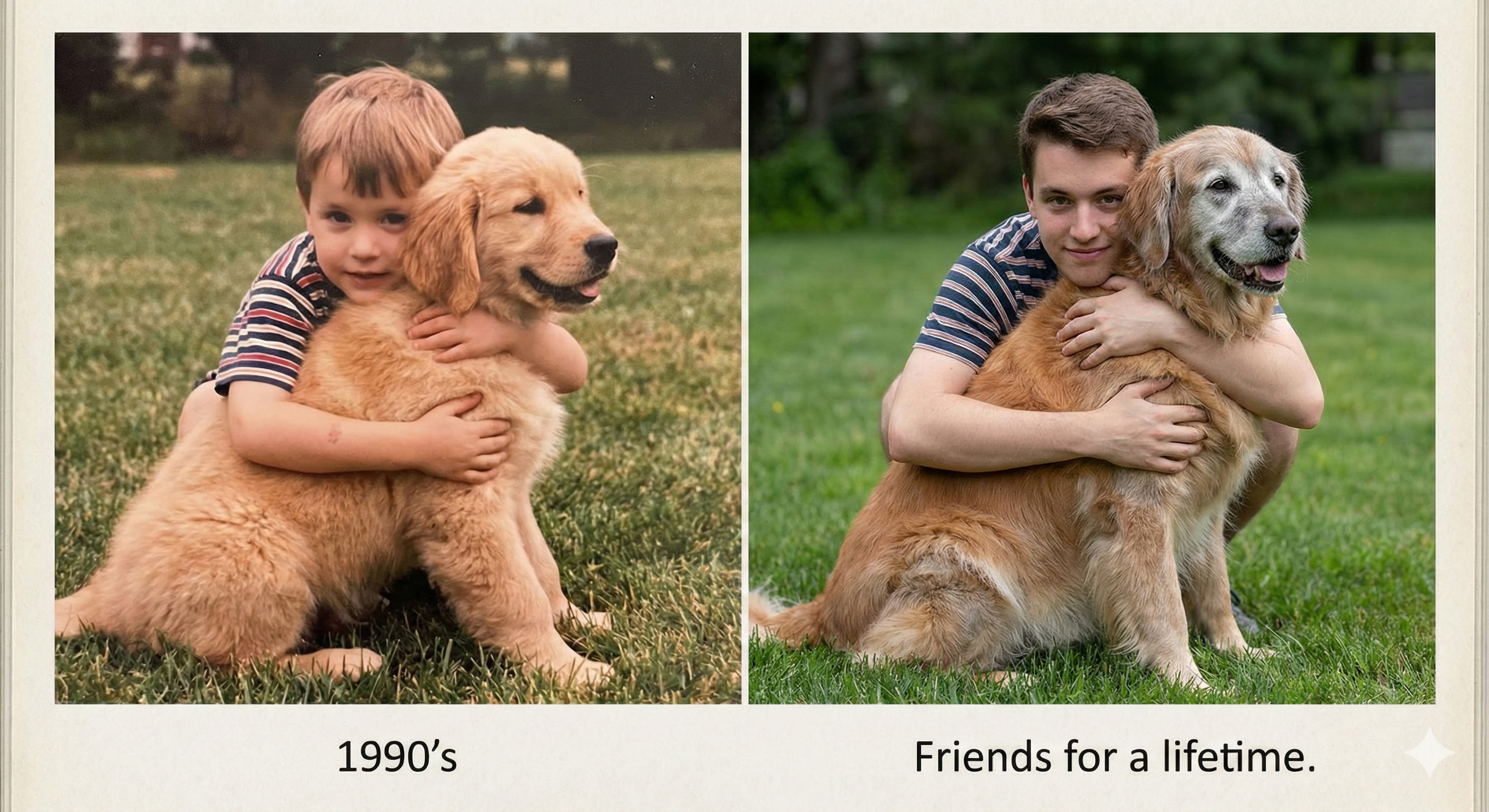
We've been asking "how do we manage decline?" It's time to ask, "How do we prevent it?"
Something is shifting in veterinary medicine. You can feel it in the research emerging from the Dog Aging Project. You can see it in the genomic tools landing on clinic desktops, tools that would have looked like science fiction a decade ago. You can hear it in the conversations pet owners are having — people who've read about longevity medicine and are quietly, insistently asking: why isn't anyone doing this for my dog? The answer, until very recently, was infrastructure. Veterinary medicine has never had the knowledge base to support a genuinely new kind of practice. Without that base, even the most visionary clinicians have been limited, forced to practice within the constraints of a system built for a different era, asking smaller questions than the moment demands. That era is ending. We are at the convergence of three things that have never existed simultaneously before: a science of biological aging sophisticated enough to identify real targets for intervention, a generation of precision diagnostic tools capable of revealing individual animal biology in extraordinary detail, and, for the first time, an intelligent clinical infrastructure built to support the medicine those two make possible. OpenVet is that infrastructure. And what it enables isn't just better veterinary care. It's a fundamentally different vision of what veterinary medicine can be.
We've Been Asking the Wrong Question
For as long as most practitioners can remember, the organizing question of veterinary medicine, especially in the back half of an animal's life, has been: how do we manage this? How do we manage the joint disease? The cardiac changes? The renal decline? The inevitable, accumulating losses that come with age across every species we care for? That question produced real advances. Pain management improved. Palliative care became more sophisticated. Quality-of-life assessment frameworks gave clinicians and clients a shared language for navigating the hardest moments. These are genuine goods that represent decades of serious clinical work. However, management differs from medicine. Quality of life, which has been central to our approach to aging animals, essentially acts as a baseline. It indicates when conditions have deteriorated enough to require intervention but does not define an upper limit of well-being. It also doesn't explore what true flourishing would entail — not merely reducing suffering but enabling animals to live more fully. The question the next era of veterinary medicine is asking is different. It's not how do we manage decline? It's how do we prevent it? Not when has quality of life deteriorated enough to intervene? But what does this animal's biology look like today, and what can we do right now to give them more years of genuine vitality? That question is known as healthspan, which is set to become the guiding concept for the most ambitious, rigorous, and meaningful efforts in veterinary medicine.
What Healthspan Actually Means — and Why It Changes Everything
Healthspan is not just wellness culture dressed in a lab coat. It's not about green supplements or mere optimism. Instead, it is a rigorous scientific framework rooted in geroscience and gaining validation through clinical research, which poses a straightforward yet profound question: how many years of life are genuinely healthy? This insight is fundamental in modern biology: the diseases causing aging in our animal patients, such as cancer, cardiovascular issues, neurodegeneration, and metabolic problems, aren't random or independent events. Instead, they stem from shared upstream causes. These include chronic systemic inflammation, accelerated cellular aging, mitochondrial problems, epigenetic changes, and the gradual failure of the body's protein quality control systems. All these biological processes form the common foundation from which most age-related diseases emerge. Treat the cancer, and the inflammation that fed it remains. Manage the kidney disease, and the mitochondrial dysfunction driving it accelerates elsewhere. The diseases are symptoms. The aging biology is the disease. If this is accurate, and growing evidence supports it, then the traditional focus on treatment tailored to specific organs or diseases in veterinary care is missing the main issue. The more effective approach lies in addressing the fundamental biology of aging: reducing chronic inflammation, removing aging cells, safeguarding mitochondrial health, and detecting early signs of deviation before clinical disease develops. This is not speculative. The Dog Aging Project's TRIAD trial is investigating rapamycin, an mTOR inhibitor with a robust longevity literature in model organisms, in companion dogs, and early results are generating genuine scientific excitement. The potential: one to three additional years of healthy, vital life for a dog, equivalent to a decade or more in human terms. Liquid biopsy platforms are detecting cancer in dogs before clinical presentation, fundamentally changing the treatment options available. Pharmacogenomic screening is moving well beyond the MDR1 conversation to reshape drug selection across multiple drug classes. The science is here. What veterinary medicine has been missing is the infrastructure to practice it.
The Infrastructure Problem No One Was Talking About
Veterinary medicine has been slow to practice the kind of care its science is making possible, and here’s one reason why. There are over 30 billion animals under human care. Thousands of species. Radically different physiologies, metabolisms, drug responses, and disease trajectories. Centuries of fragmented evidence scattered across species-specific journals, textbooks written for particular specialties, and informal knowledge networks maintained by practitioners who happened to train in the right place at the right time. A general practitioner encountering an exotic species, a geriatric case outside their usual profile, or an emerging pharmacological question has historically had two options: spend hours they don't have searching through sources they can't fully trust, or rely on the patchy knowledge available to them and hope it's enough. Neither of those options is adequate for the medicine we're now capable of practicing. Precision medicine, the shift toward personalized care based on each animal's unique biology, genomics, and progression, is only as effective as the intelligence layer that interprets the data generated by these advanced tools. A genomic panel that reveals drug sensitivity is helpful only if the clinician can quickly determine how to respond. Similarly, a liquid biopsy that detects early cancer signals is valuable only when the follow-up reasoning is well-calibrated and available instantly. Additionally, a trend in geriatric bloodwork indicating early organ dysfunction is significant only if the practitioner can distinguish meaningful signals from noise without lengthy research. The knowledge infrastructure that veterinary medicine needs to support precision, health span- oriented care has never existed.
OpenVet Is Building the Backbone of What Comes Next
OpenVet is not a search engine. It is not a drug reference compendium. It is not another AI chatbot that pattern-matches to whatever prompt it receives and hopes for the best. OpenVet is the clinical intelligence layer veterinary medicine has never had: a universal medical system built for all animal species, designed to turn the world's fragmented veterinary knowledge into structured, evidence-based, verifiable guidance that practitioners can use at the point of care. The architecture of OpenVet's approach reflects a deep understanding of what veterinary medicine needs right now. When a clinician asks a question, whether it's about drug dosing in an exotic species, the significance of a creatinine trend in an aging cat, or the evidence base for a biomarker screening in a geriatric dog, OpenVet doesn't just retrieve information. It classifies the question, gathers context, prioritizes canonical veterinary literature and peer-reviewed research, and returns a structured answer: stated assumptions, confidence scores, and citations. Everything visible. Everything traceable. The reasoning is shown, not hidden. And then the clinician makes the call. That final point, you make the call, is not a legal disclaimer. It's a philosophy. It reflects an understanding that the core issue in veterinary medicine isn't a lack of clinical judgment. Veterinarians who have gone through veterinary school, developed pattern recognition and clinical instincts over years, and possess genuine expertise in animal care are not the problem. Instead, the challenge lies in the gap between the existing knowledge and the knowledge they need during treatment, in the right form and at the right time. OpenVet closes that gap. It amplifies clinical judgment rather than replacing it. It gives practitioners the confidence to ask bigger questions, consider more complex interventions, and practice the kind of proactive, precision-oriented medicine that the healthspan framework demands across every species, every condition, every stage of life.
What This Looks Like When It's Working
Imagine a general practitioner seeing a seven-year-old Golden Retriever for a routine annual visit. Under the current paradigm, the visit is reactive: check the bloodwork, note any changes, counsel the owner on dental health and weight, and send them home. If values are acceptable against population reference ranges, no intervention. Under a healthspan paradigm supported by OpenVet's clinical intelligence, that visit looks different. The practitioner reviews a longitudinal profile and notices a subtle upward trend in creatinine over three years — still within the normal range but moving in a direction that warrants attention. They query OpenVet: what does the current evidence say about early renal- protective interventions in aging large-breed dogs, and which monitoring parameters should inform the decision? In seconds, they receive a structured, cited answer that draws on the best available evidence across nephrology, nutrition, and geriatric medicine. They leave the appointment with a proactive monitoring plan, a dietary recommendation, and a conversation with the owner about what healthy aging for their dog looks like and what might be possible to preserve. That conversation is different. It's not about managing the decline the owner dreads. It's about building the healthspan the owner hopes for. It changes the emotional register of the entire relationship between practitioner, patient, and family. Now scale that across the full spectrum of veterinary practice. The wildlife rehabilitator is managing a recovering raptor's long-term metabolic health. The exotic animal practitioner is navigating drug dosing in a species with almost no published veterinary literature. The equine veterinarian is considering anti-inflammatory protocols for an aging performance horse. The emergency clinician at 2 am facing a complex presentation without a specialist to call. Every one of these practitioners deserves the same level of clinical intelligence support. OpenVet is building that for all of them, not for a single species or specialty, but for the entire breadth of animal medicine. This is not an incremental improvement. It's a different practice category.
Precision Medicine's Missing Piece
The precision medicine revolution in veterinary medicine is real and accelerating. Genomic screening. Liquid biopsy. Microbiome analysis. Continuous physiological monitoring. Pharmacogenomics moving beyond MDR1 to reshape drug selection across multiple therapeutic classes. Proteomics and metabolomics are moving steadily from research settings toward clinical application. Each of these technologies provides a more detailed window into individual animal biology than the field has ever had. And each of them generates the same downstream requirement: a clinician who can synthesize what they reveal, quickly and confidently, and translate the data into action. That's not a criticism of practitioners. No human mind can reliably synthesize multi-domain, multi-species evidence under time pressure without support. The most brilliant specialist in the world has deep but necessarily narrow knowledge. The general practitioner who manages the full spectrum of cases has breadth that no single person can keep fully current. The gap between what precision medicine can reveal and what any individual practitioner can act on unaided is not a failure of veterinary education. It's a structural feature of a field whose knowledge base has grown faster than the infrastructure to access it. OpenVet is the infrastructure. It is what makes precision medicine work in the clinic, not just in the research paper, not just for the well-resourced specialist practice, but everywhere, for every practitioner who has the clinical judgment to use it. As diagnostic tools continue to proliferate and they will, faster than most practitioners expect the limiting factor in their clinical value will increasingly shift from test quality to the quality of the intelligence layer interpreting the results. OpenVet is building that layer now, deliberately, with a safety-first architecture, clinician-led development, and an evidence standard that treats rigor not as a constraint on helpfulness but as its foundation.
The Science of Aging Is Catching Up. The Infrastructure Needed to Match It.
The Dog Aging Project. Rapamycin trials in companion animals. Epigenetic clocks are being validated across species. Senolytic research expanding into veterinary applications. The emerging science of veterinary geroscience is not fringe; it's mainstream, well-funded, and producing results that are beginning to translate into clinical options. What has been missing is not the science. It's the infrastructure to practice it. Geroscience tells us that aging is modifiable; the biological processes that drive it are not inevitable features of time but targetable mechanisms that can be slowed, interrupted, or even partially reversed. That insight demands a new posture from veterinary medicine: not waiting for disease to appear but intervening in the biology that produces it. Not treating cancer after diagnosis, but monitoring the signals that precede it. Not managing decline but investing in vitality. That posture requires practitioners who are well enough supported to act on what the science reveals. It requires a knowledge infrastructure that keeps pace with a research base evolving faster than any individual can track. In short, it requires exactly what OpenVet is building. OpenVet's vision is not to be one tool among many. It is to be the backbone of veterinary medicine practices, the universal medical system that ensures every clinician, regardless of species specialty, geographic setting, or available specialist support, can access the best available evidence when it matters most. The intelligence layer that makes precision medicine real enables healthspan-oriented care and makes the next era of veterinary practice, the era we are just now entering, and something the field can actually deliver on.
This Is the Moment
Veterinary medicine is at an inflection point. The science of healthy aging in animals is mature enough to guide clinical action. Precision diagnostic tools are accessible enough to generate individual-level biological insight at scale. And the knowledge infrastructure to support the medicine this moment demands is being built, right now, by a team that understands both the clinical complexity and the stakes. The question the profession faces is not whether this future arrives. It's already here. The question is whether veterinary medicine meets it with the tools and frameworks that let practitioners lead — or scrambles to catch up later, in the wake of pet owners who figured it out first and researchers whose findings never made it to the clinic in time. OpenVet's answer to that question is clear: build the infrastructure now, build it right, build it for every species and every practitioner, and let the clinical intelligence layer do what it was designed to do: turn the world's veterinary knowledge into the confidence every animal deserves. The era of managed decline is ending. The era of genuinely extending animal healthspan is beginning. The infrastructure is ready. The science is here. The question now is only how quickly the profession chooses to step into it.